
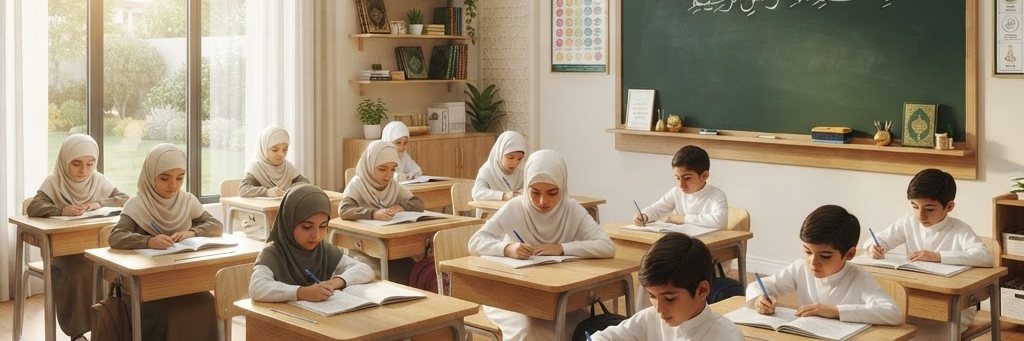
How we teach
Qur'an in the morning while the children are fresh, school subjects through the middle of the day, deeni subjects until two. Seven levels, Nursery to Class 5, one teacher to each.
How the teaching is organised
- Small sittings for the Qur'an
- The morning Qur'an lesson is taken in small sittings so each child reads aloud to the teacher every day. A child cannot be corrected if they are never heard.
- One teacher to a class
- Each class has one teacher who takes it for the school subjects and stays with the class for the year. They know which child is struggling without having to be told.
- Repeat the lesson, not the year
- A child who has not understood the day's lesson is taken again after two o'clock rather than left to fall behind until the exam finds it.
The subjects
Ten subjects across the day. The deeni subjects run at both ends of the morning; the school subjects sit in the middle, when the children are settled.
Deeni
The religious subjects
- Qur'an
- Reading the Qur'an correctly, from Qaida through to fluent recitation.
- Hifz
- Memorisation, para by para, at the child's own pace. Not every child takes this and no child is pushed into it.
- Tajweed
- The rules of pronunciation — how each letter is sounded and where to stop.
- Arabic
- Reading and writing Arabic, and enough grammar to follow what is being recited.
- Islamic Studies
- Prayer, the pillars, the life of the Prophet ﷺ, and how to behave with people.
Duniyawi
The school subjects
- Nepali
- Reading, writing and composition — the language the child will be schooled and examined in after they leave us.
- English
- Alphabet and phonics in Nursery and LKG, through to reading and writing sentences by Class 5.
- Mathematics
- Counting and tables through to fractions, measurement and simple geometry.
- Urdu
- Reading and writing, for families who use it at home.
- General Knowledge
- The world around the child — the country, the body, plants, weather, safety.
Year by year
What a child can do at the end of each year, rather than what is covered in it.
Nursery: Settling, sounds and speech
3 to 4 years
The first year in the building. The child learns to sit in a class, to hold a pencil, and to say the Arabic letters after the teacher. Nothing is written down yet.
LKG: Letters on paper
4 to 5 years
Writing begins — the Arabic letters from the Qaida, and the Nepali and English alphabets. Counting to fifty.
Class 1: Qaida and joining letters
5 to 6 years
The child works through the Qaida and begins to join letters into words. In the school subjects: writing full words, and counting to a hundred.
Class 2: Reading begins
6 to 7 years
Qaida is finished and the child begins to read short surahs. Writing sentences in Nepali and English, addition and subtraction.
Class 3: Into the Qur'an
7 to 8 years
The child starts reading from the Qur'an itself with a teacher beside them. Tajweed starts properly. Tables, and writing a short paragraph.
Class 4: Fluency
8 to 9 years
Reading the Qur'an without help on familiar passages. Arabic reading and writing starts. Multiplication, division and money problems.
Class 5: Finishing well
9 to 10 years
The last year with us. Arabic grammar begins, so the child follows the meaning and not only the sound. Fractions and measurement, and enough Nepali, English and Mathematics to join Class 6 at any school in the district.
Who teaches your child
The deeni subjects are taught by qualified ulama; the school subjects by teachers who hold a degree in the subject they teach. Girls are taught by women teachers.
How you will know how your child is doing
- Attendance, every morning
- The register is taken at the start of the day and the office knows who is in the building by half past seven. Call and ask on any day.
- Three exams a year
- First terminal, half-yearly and annual. Every subject, deeni and duniyawi, is examined.
- A printed marksheet
- After each exam your child brings home a marksheet with every subject, the total, the percentage, the grade and their attendance for the term.
- Promotion at the end of the year
- A child who is ready moves up. A child who is not is told honestly, and we will explain exactly what they need to work on rather than moving them along quietly.
See a class running
The best way to judge any of this is to stand at the back of a classroom for ten minutes. Come in the morning and ask.